Books & Research

Explore my book with sample code and chapter guides, followed by research papers on recommender systems.

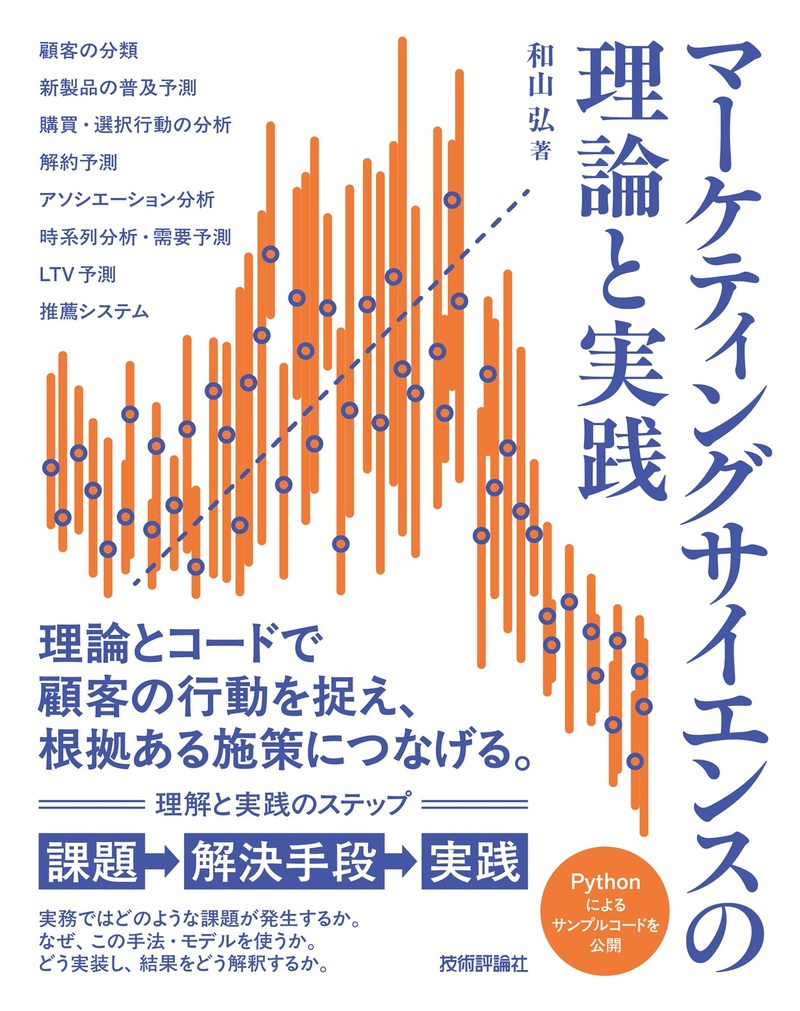
Cover of Marketing Science in Theory and Practice (Japanese edition)

BOOK & READER RESOURCES

Marketing Science in Theory and Practice

マーケティングサイエンスの理論と実践

Written in Japanese · English chapter guides available below

Hiroshi Wayama

Gijutsu-Hyoron · Scheduled for

The book covers customer segmentation, purchasing behavior, churn, sales and customer value prediction, and recommender systems. It connects the business question with mathematical models, Python implementations, and interpretation of the results.

Who this book is for

  • Data scientists and analysts working on marketing problems.
  • Machine learning and software engineers who want to connect mathematical models with implementation.
  • Marketing planners and strategists who want to understand model assumptions and use analytical results in their decisions.

What the book covers

  • Understand customers: segmentation, choice and purchase models, and differences between consumers.
  • Forecast outcomes: product adoption, churn, sales, and customer lifetime value.
  • Build recommendations: co-purchase analysis, collaborative filtering, and graph neural networks.

Each topic connects problem formulation, theory, Python implementation, and interpretation.

Prerequisites

Basic Python, probability and statistics, calculus, and matrix operations. The support repository explains how to set up the environment and prepare the data. The book is written in Japanese; the chapter explanations linked below are available in English.

Chapter guides and supplementary explanations: chapters 2–12

Read each chapter guide or open its code. For environment and data preparation, see the support repository.

Explanations and sample code by chapter
ChapterTopicResources
2Grouping customers from purchase histories: k-means and GMM
3When do new-product sales peak? Forecasting adoption with the Bass model
4How do price and performance affect product choice?
5Can purchase counts alone describe a brand's position?
6Estimating individual responses to price with a hierarchical Bayesian model
7Predicting churn: from survival analysis to testing retention actions
8Finding products bought together with association analysis
9Decomposing sales changes and forecasting with Prophet and state-space models
10Predicting future customer value from purchase histories
11Building personalized recommendations from purchase histories
12Choosing recommendations from connections in purchase histories

View prerequisites and chapter summaries

About the author

Hiroshi Wayama studied physics and worked in semiconductor development, numerical computing, and software systems before becoming independent. His work combines applied machine learning and data analysis with research on recommender systems.

Read the author’s profile

Updates

Updates to the code and setup instructions are maintained in the support repository. For publication and purchase information, see the publisher’s page.

Research papers

Research on recommender systems using graphs, random walks, and quantum models, with paper summaries and background reading.

My research asks how recommender systems can offer relevant items while exposing users to a wider range of choices. I model user–item interactions as graphs and study information propagation through PageRank and quantum walks.

The work connects ideas from physics and linear algebra with algorithm implementation and evaluation. See About for professional experience and business activities.

2025

Generalized Personalized PageRank with Graph Convolutional Networks in Recommender Systems

Hiroshi Wayama, Kazunari Sugiyama
ICTIR 2025 · pp. 380–389 · Padua, Italy

Question
Can controlled graph propagation improve both relevance and diversity?
Method
GPPR and APPR extend PageRank and are incorporated into LightGCN.
Findings
The reported experiments improve on LightGCN in relevance and diversity. The propagation matrices are also analyzed as low-pass filters.

2023

The Effectiveness of Quantum Random Walk Model in Recommender Systems

Hiroshi Wayama, Kazunari Sugiyama
ICTIR 2023 · pp. 225–234 · Taipei, Taiwan

Question
How can a quantum-walk representation change recommendation on a graph?
Method
A continuous-time quantum walk is used to reconstruct LightGCN's user–item adjacency matrix.
Findings
The study reports improved relevance and diversity.

2023

A Recommender System Using Quantum Models

量子モデルを利用した推薦システムの提案

和山 弘 / Hiroshi Wayama, 杉山 一成 / Kazunari Sugiyama
日本データベース学会和文論文誌 / DBSJ Japanese Journal · Vol. 21-J · Article No. 3 · 2023-03 · Written in Japanese

Question
Can quantum walks enrich a binary user–item graph?
Method
Two recommendation models construct adjacency matrices using quantum-walk mixing.
Findings
Top-ranked results were comparable to LightGCN. One variant improved diversity lower in the ranking, with added computation and memory costs from dense matrices.